
Exhibit Contents
- The Forbidden City, Pekin & Chinese Views Souvenir Playing Cards
- Playing Cards Decorated with Constructed Information
Playing Cards Decorated with Constructed Information
This Forbidden City deck, advertised as able to be “mailed to any address” in America, sold originally with a sixteen-page booklet, offering a brief yet often misleading history of China and descriptions of the photographic scenes printed on each playing card.1 The booklet organizes the descriptions according to the four suits—spades, clubs, diamonds, and hearts—each with relatively distinct thematic associations.
The Spades suit depicts scenes emphasizing imperial authority and exclusive spaces in Beijing, notably within the Forbidden City and various imperial palaces. Because these locations were traditionally inaccessible to foreigners, their photographic representation implicitly celebrated the successful occupation of the capital by the Eight-Nation Alliance. For example, the Five of Spades (Figure 1) shows the “Entrance Gate to [the] Ancient Hall for Receiving Visits of Civil and Military Functionaries in the Precinct of Imperial Palace, Pekin.” The booklet emphasizes that “No foreigner is ever allowed inside the Imperial Palace except on state occasions, and there are some parts of the Palace which no foreigner has ever invaded. The Ancient Hall is one of these places.”2 During the Boxer conflict, however, the Eight-Nation Alliance penetrated not only this gate but also other previously inaccessible areas.
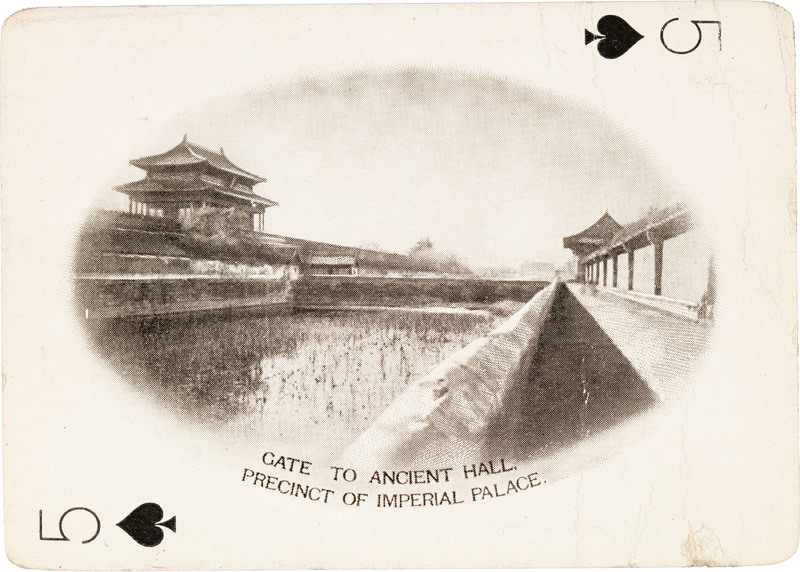
Figure 1
The Clubs suit showcases iconic historical landmarks and religious sites around Beijing, such as the Great Wall, city gates, and temples. These images reinforced Western perceptions of China as culturally and religiously distinct from the West—differences that Western observers at the time claimed had contributed significantly to the Boxer conflict. An example is the Nine of Clubs (Figure 2), depicting the Temple of Light. The booklet describes it as representative of how “Pekin is filled with temples dedicated to various forms of worship,” emphasizing the cultural and religious differences in China.3
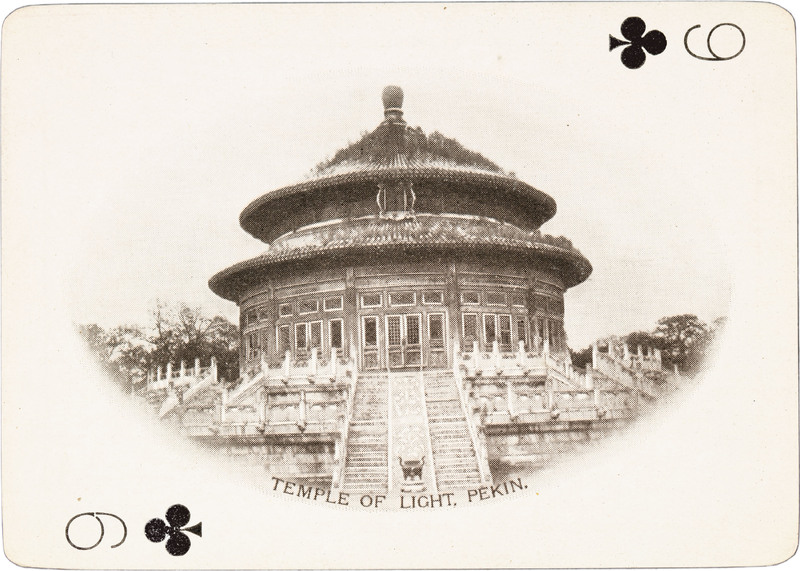
Figure 2
The Diamonds suit specifically illustrates events related to the Boxer Rebellion, featuring scenes from the siege, the foreign legation quarters, and the widespread destruction resulting from the conflict. These images strongly supported Western narratives by justifying the military intervention and invasion. For instance, the Five of Diamonds (Figure 3) highlights the destroyed German Legation building, and the booklet emphasizes that it was near the site where the German Minister was killed by Boxers.4
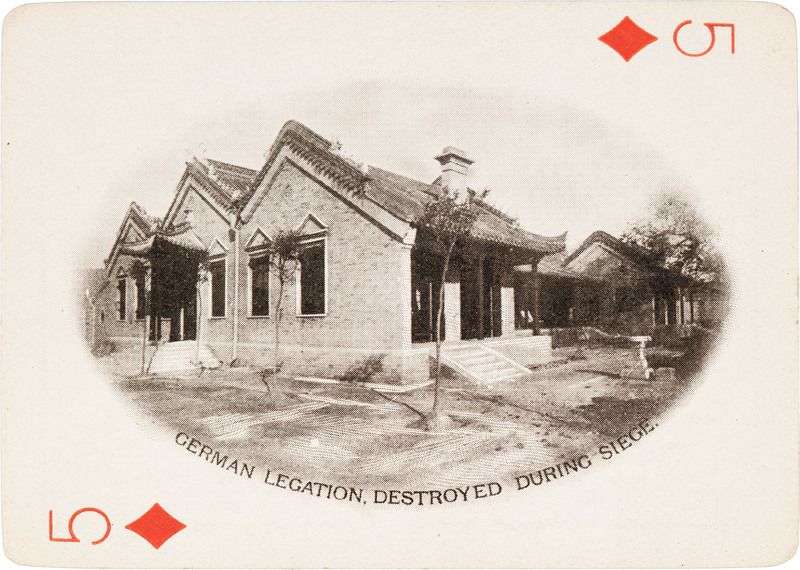
Figure 3
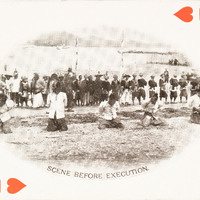
Finally, the Hearts suit presents provocative and exaggerated portrayals of punishments, executions, opium use, and exoticized social customs, reinforcing harmful stereotypes about Chinese brutality and moral decay. A notable example is the Two of Hearts, falsely described as showing the “Scene Before Execution of Fifteen Boxers.”5 In reality, however, the image depicts an unrelated event, deliberately misrepresented to amplify violence and thereby provide further justification for foreign military actions.
Citation
1. We would like to express our gratitude to Jane Siegel, Rare Book Librarian, Rare Book and Manuscript Library, Columbia University Libraries for sharing the contents of the booklet.
2. Grimes-Strassforth, “The Forbidden City” Souvenir Playing Cards (Grimes-Stassforth Stationery Company, 1901), 6.
3. Ibid, 9.
4. Ibid, 11.
5. Ibid, 14.
Previous Section:
Boxer Rebellion: A Contested History
Next Section: